
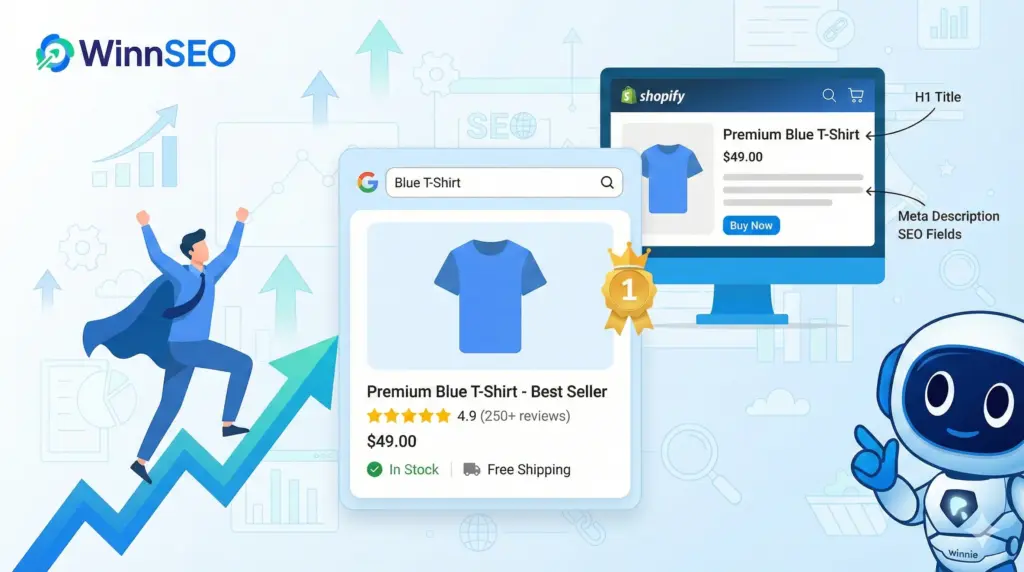

If your Shopify store isn’t getting enough traffic, isn’t ranking for important keywords, or your product pages feel “invisible” on Google, the problem is almost always on-page SEO.
The truth?
Shopify doesn’t rank by itself.
Even the best theme, the fastest hosting, or the prettiest product page won’t matter unless your on-page SEO is clean, structured, keyword-optimized, and error-free.
And in 2026, Google is even stricter:
- Thin content doesn’t rank
- Duplicate product descriptions don’t rank
- Un-optimized images don’t rank
- Slow-loading Shopify pages don’t rank
- And missing metadata destroys visibility
The good news:
This is the only guide you need to fix everything — fast.
This guide blends:
- Professional SEO expertise
- Beginner-friendly explanations
- SaaS-style clarity with examples
- Top 1% tactical insights
Plus, we’ll show where automation tools like WinnSEO save hours of manual optimization.
Let’s begin.
What Is Shopify On-Page SEO? (Simple Explanation)
Shopify on-page SEO is the process of optimizing every individual page on your Shopify store so Google can understand:
- What your page is about
- Who it’s for
- What keywords it should rank for
- Whether it’s high-quality
- Whether it deserves to appear on page #1
On-page SEO includes optimizing:
- Titles
- Meta descriptions
- Product descriptions
- Image alt tags
- URLs
- Internal links
- H1/H2 headings
- Structured data
- Page content quality
- Page speed
- Mobile experience
If your on-page SEO is clean, your store will rank.
If it’s broken… you won’t.
This guide fixes that.
Why On-Page SEO Matters More Than Ever in 2026
Google’s latest updates reward:
✔ High-quality content
✔ Clean structure
✔ Faster pages
✔ Unique descriptions
✔ Clear product data
✔ Internal linking
✔ Schema markup
And they aggressively punish:
✘ Duplicate descriptions
✘ Thin pages
✘ Slow store loading
✘ Messy URLs
✘ Missing alt tags
✘ Keyword stuffing
For Shopify stores, on-page SEO directly affects sales because:
- Better rankings → more organic traffic
- Better product pages → higher conversion rate
- Better internal links → more pages indexed
- Better metadata → higher click-through rate
- Better schema → more rich results
This is why the biggest brands (Gymshark, Kylie Cosmetics, Allbirds, and even Netflix Merch) follow strict on-page SEO playbooks.
This guide teaches you their playbook, plus the automation.
The Complete Shopify On-Page SEO Checklist for 2026
This is the complete list we will go through:
Table of Contents
1. Keyword Research for Shopify (Beginner-Friendly + Expert Level)
Before optimizing anything, you must know what people search for.
Types of keywords Shopify stores must target:
| Keyword Type | Example | Target Page |
| Transactional | “buy black leather backpack” | Product page |
| Commercial | “best leather backpacks” | Blog |
| Navigational | “BrandName backpack” | Homepage |
| Informational | “how to clean leather bags” | Blog |
| Category keywords | “women’s leather bags” | Collection page |
Free keyword tools you can use:
- Google Autocomplete
- Google People Also Ask
- Google Keyword Planner
- AnswerThePublic
- Pinterest Search
- TikTok Search
Paid tools (if available):
2. Build an SEO-Friendly Store Structure (Google Loves Clean Hierarchy)
Ideal structure:
Home
└── Collections
├── Sub-Collections
└── Products
But Shopify has limitations:
➤ Shopify doesn’t allow real nested sub-collections.
➤ But you can simulate hierarchy with smart navigation.
Example from top-ranking stores:
- Gymshark uses clean URLs, structured collections, and internal navigation
- Mack Weldon uses filters + strong collection descriptions
Your goal:
✔ Organize products into tightly themed collections
✔ Avoid dumping 100+ products into one category
✔ Add 150–300 words of SEO text to each collection
3. Optimize Shopify Product Titles (Your H1 Tag)
Your product title is the most powerful on-page SEO element.
Formula that ranks in 2025:
Primary keyword + key feature + model/variant
Example:
❌ “Leather Bag”
✔ “Premium Leather Laptop Bag – Waterproof, 15-Inch, Brown”
Why?
Google understands context better, and buyers click more.
4. Write High-Converting Product Descriptions
Google wants unique, helpful, keyword-rich descriptions, not AI-generated fluff.
Your product description must include:
✔ 300–600 words
✔ First 100 words include the primary keyword
✔ Bullet points
✔ Benefits, not just features
✔ Use cases
✔ Material details
✔ Dimensions
✔ Care instructions
✔ Internal links
✔ FAQ section (optional but powerful)
Example structure Google loves:
1. The Hook (1–2 sentences)
State the problem the product solves.
2. Benefits-first paragraph
Why this product is the best choice.
3. Feature bullets
Short, skimmable.
4. Story-based section (optional)
Brand values, craftsmanship, quality.
5. SEO keywords sprinkled naturally
5. Collection Page Optimization (Most Stores Ignore This!)
Collection pages rank for big traffic keywords, like:
- “women’s dresses”
- “men’s hoodies”
- “baby toys”
To rank collections:
✔ Add 150–300 words of SEO text
✔ Add H2 subtitles under the banner
✔ Use internal links
✔ Optimize filters
✔ Add unique meta title + description
✔ Add “Shop Top Categories” blocks (Google loves this)
Most Shopify merchants skip this and lose rankings.
6. Image SEO (The Secret Traffic Source)
Google Images is the second largest search engine inside Google.
Optimize every image:
✔ Rename the image file
❌ IMG_4412.jpg
✔ black-leather-backpack-men.jpg
✔ Add descriptive alt tags
✔ Compress images
✔ Use WebP format
✔ Keep sizes under 200 KB
This improves:
- Rankings
- Accessibility
- Load speed
- Conversion rate
7. Meta Titles & Meta Descriptions (Click-Through Rate Machine)
Meta Title Formula
Primary Keyword + Modifier + Brand
Example:
“Shopify On-Page SEO Guide (2026 Update) – WinnSEO”
Meta Description Formula
Benefit + Keyword + CTA
(155–160 characters)
Example:
“Learn Shopify on-page SEO with 2026 strategies to rank higher, fix errors fast, and automate optimization with WinnSEO. Boost sales today.”
8. Internal Linking (Most Powerful On-Page SEO Signal)
Google follows links to:
- Understand relationships
- Distribute authority
- Crawl deeper pages
Use these internal linking rules:
✔ Link blogs → collections
✔ Blogs → products
✔ Collections → best products
✔ Products → related collections
✔ Homepage → top categories
This creates a powerful SEO silo structure.
9. Add Schema Markup (Rich Results Booster)
Shopify includes some schema, but it’s limited.
You should add:
- Product schema
- Breadcrumb schema
- FAQ schema
- Review schema
- Price schema
- Availability schema
- Article schema
- Local business schema (optional)
Why this matters:
✔ Stars in Google
✔ FAQ dropdown results
✔ Pricing in SERP
✔ Higher CTR
✔ Better indexing
10. Boost Page Speed (Core Web Vitals)
Google ranks fast stores higher.
Fix this:
✔ Compress images
✔ Remove unused apps
✔ Minify CSS/JS
✔ Use lazy loading
✔ Reduce third-party scripts
✔ Use fast themes like Dawn / Ride / Sense
Even a 0.5-second improvement = higher sales.
11. Make Your Store Mobile-First (Google Priority)
77% of Shopify traffic comes from mobile.
Checklist:
✔ Buttons must be thumb-friendly
✔ Text should be readable without zooming
✔ Mobile menu easy to navigate
✔ Product page loads under 2.5 seconds
✔ Images responsive
✔ Checkout smooth
Google’s mobile-first indexing means:
If it’s not optimized for mobile, it won’t rank.
12. Critical Shopify SEO Mistakes to Avoid
These mistakes destroy rankings:
❌ Duplicate product descriptions
❌ Too short content (<120 words)
❌ Keyword stuffing
❌ Missing alt tags
❌ Auto-generated URLs
❌ Thin collection pages
❌ Slow apps
❌ No internal links
❌ Unoptimized blog posts
Avoid them at all costs.
13. Automating On-Page SEO with WinnSEO (2026 Advantage)
Most merchants fail at SEO because it takes time.
This is where automation makes a huge difference.
WinnSEO instantly automates:
✔ AI-written meta titles
✔ AI-written meta descriptions
✔ Product description SEO optimization✔ Keyword Research
✔ Bulk SEO fixes
✔ URL optimization
✔ Image alt text automation
✔ Competitors Analysis
✔ On-page error detection
✔ Internal linking recommendations
Why automation wins:
- Saves 80% manual work
- Fixes hundreds of pages at once
- Prevents human errors
- Ensures Google compliance
- Keeps pages updated automatically
This is the future of Shopify SEO.
And WinnSEO is early.
14. Shopify On-Page SEO FAQs
1. What is Shopify on-page SEO?
It’s the process of optimizing product pages, collections, images, titles, metadata, and content so they rank higher in Google.
2. Does on-page SEO improve Shopify sales?
Yes. Better rankings → more traffic → more conversions.
3. How long does it take to rank Shopify pages?
With proper on-page SEO: 4–12 weeks.
4. Do I need apps for Shopify SEO?
Apps help automate the boring parts — especially metadata and alt tags.
5. Can I automate Shopify SEO?
Yes. Tools like WinnSEO automate on-page optimization, alt tags, structured data, and meta fields.
Final Thoughts: On-Page SEO Is Your #1 Shopify Growth Lever
Most Shopify stores don’t have an ads problem —
They have an SEO problem.
If your product pages are:
✔ slow
✔ thin
✔ duplicate
✔ unoptimized
…no amount of ads or social media will fix it.
But once your on-page SEO is strong, Google begins sending free traffic, daily, automatically.