

Being a Shopify store owner, you may see thousands of online stores competing for attention. And On-Page SEO is something you just can’t ignore today. In short, it’s all about making sure your individual pages are optimized correctly.
Don’t worry, it’s not a complicated task at all.
In this blog, we’ll break down what On-Page SEO is and why it matters for Shopify websites. Also, it’ll teach you how to gain long-term growth for your store, even if you’re not an SEO expert.
Table of Contents
What is On-Page SEO?
On-Page SEO means optimizing the content and structure of your web pages, like the product page, blog page, and even the homepage. If done right, you can successfully make your site “Google-friendly.”
It includes things like:
- Choosing relevant keywords to optimize the product titles, descriptions, content, and image ALT texts, URL, etc.
- Crafting a good meta title & description that shows up in search results
- Using proper headings like H1, H2, H3 in your content
- Ensuring quick-loading pages that work well on mobile
However, if you see off-page SEO (like backlinks) and technical SEO (like fixing crawl errors), they are not under your control. But on-page SEO is absolutely under your control. Shopify makes it pretty easy to manage.
Key Benefits of On-Page SEO for Shopify Stores
Let’s discuss how this SEO technique helps your store rank higher, attract more visitors, and convert them into customers.
1. On-Page SEO Improves Search Engine Visibility
Here we’ll talk about the importance of headings in content.
Imagine you sell “Leather Handbags”. But if you give the title just “Vintage”, Google won’t understand what it is.
So, how will Google get more context? Well, you may write something like “Designer Vintage Leather Handbags.” Thus, you increase your chances of showing up in search results go way up.
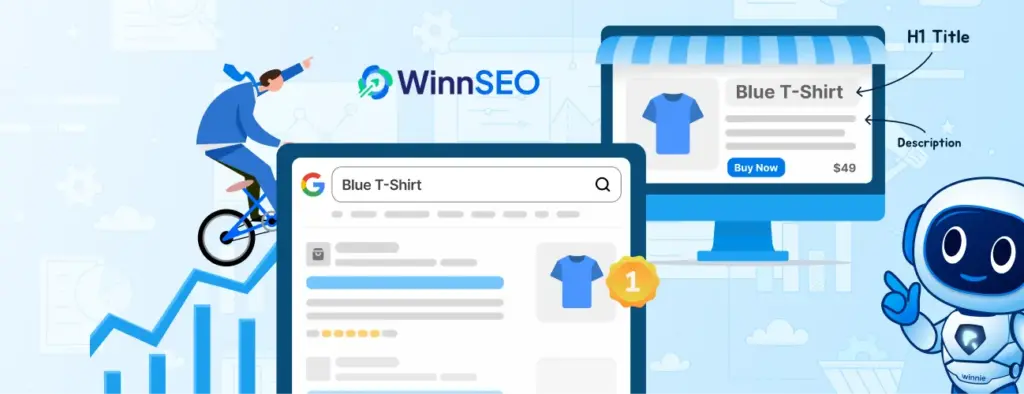
Also, using proper heading tags like H1 for the main title, H2, H3, and others for subheadings helps Google scan and grasp your page content faster.
2. Get More Organic Traffic
You know the best part of on-page optimization? The free traffic.
When your pages are optimized, they’re more likely to appear when people search for things related to your products. Suppose someone searches for “leather handbags for gifts”. If your product page is optimized with the related keyword in the title, description, and headings, then boom!
Without paying a cent for ads, SERP will display your product.
3. Enjoy Good UX Advantage
Good On-Page SEO isn’t just for search engines, it gives you a good UX experience. Here’s how:
- Good UX = Fast-loading pages. It means people won’t leave a fast-loading site out of frustration.
- Mobile-friendly design ensures your Shopify store looks good on any device.
- Simple navigation helps customers find what they need faster.
Assume you’ve a real physical store. If it’s messy, slow, or hard to move around in, visitors won’t stay longer. Here on-page SEO steps to help you create a clean, smooth shopping experience.
4. Optimizes Individual Product Pages
Each product on your Shopify site deserves its own spotlight. That means optimizing a single product page with:
- Clear and keyword-rich title
- The right URL (like /vintage-leather-handbag instead of /product123)
- High-resolution images with ALT text (like alt=” vintage handbags made with pure leather”)
- A detailed product description that answers questions
For instance, if you’re selling leather handbags, don’t just say “leather handbags“. Try something like: “Genuine leather handbags with vintage style and modern function”
This helps both search engines and buyers understand what you’re offering.
5. The Long-Term On-Page SEO Impacts Shopify Store Growth
In terms of long-term positive impacts, you certainly can’t get them with paid ads. How long will it serve you if your budget runs out? But on-page SEO keeps delivering results long after you hit “save.”
Here’s how it helps in the long run:
- Your optimized best pages continue to rank and bring in traffic month after month.
Want to know how Google search works?
Check this guide by Google: Search Engine Optimization (SEO) Starter Guide
- You build strong authority in your niche (especially if you blog regularly, too)
- Your cost per acquisition (CPA) goes down because you’re getting free traffic.
To establish yourself as a successful seller with Shopify and reduce your CPA with consistent and high-quality content, here’s what you should read:
Cost per action: Definition
About Target CPA bidding - You’re not fully dependent on paid ads or social media boosts
Example: Your friend has started a small brand and optimized the product pages using keywords like “wooden modern designer furniture ”. Within a few months, he started getting hundreds of visitors per week from Google alone, without any extra ad spend.
Of course, it may take some time and a bit of effort up front, but it pays off big time down the road.
Common On-Page SEO Elements to Focus On
If you’re just getting started, know about these important elements that significantly impact your on-page SEO:
- Keyword research: Keywords are popular words and phrases. Keyword research is the process of finding those words and phrases people use when searching for information related to your business. By understanding the concept, you can find suitable keywords for your content and incorporate them correctly. The right keywords help to improve your content’s visibility.
See the example- If you sell handmade bags, the related keywords might be: handmade bags, handmade bags crochet, handmade travel bags, handmade leather bags, etc. That means you have to pick the phrases that people search for frequently. - Content quality: The quality content is always informative. Those are engaging and provide value to the reader. Search engines prioritize well-written, original content that truly answers a searcher’s query.
Instead of just listing your Shopify product features, you should try to craft high-quality product pages. For instance, if you craft content about a coffee maker, don’t just describe the features; include brewing tips, a comparison with other models, customer reviews, and other relevant insights.
Are you producing helpful content?
See what is helpful, reliable, and people-first content according to Google.
- Title Tags: These are the clickable headlines or titles that appear in search results.
If you’re selling running shoes, a good title tag might be: “Top 10 Best Running Shoes for Men & Women in 2025 | [Your Brand Name]” Here, “Top 10” grabs attention, adding the year (“2025”) boosts freshness and CTR, brand name at the end keeps it clean and recognizable. - Meta Descriptions: These are descriptions, appear below your title tag in search results. Good meta descriptions should be the summaries of the main content or page, with a call to action. It makes people click to check the full details.
For your running shoes page, the meta description could be: “Discover the best running shoes for men & women, perfect for road, trail, and gym. Shop top brands and latest styles today at [Your Brand Name].” The description is perfect, directly addresses user needs for road, trail, or gym use, making it highly relevant. It also uses strong action verbs like “Discover” and “Shop” with a subtle call to urgency (“today”). - Headings (H1, H2, H3): H1 is typically your main page title, H2s and H3s are subheadings. These headings organize your content into logical sections. They make it easier for both users and search engines to read and understand.
Say, you’ve an article about “Benefits of Yoga”. Here “Benefits of Yoga” should be H1 or the main title, then H2s for “Improved Flexibility” and “Stress Reduction,” with H3s for specific poses under each. - Product Descriptions: This content is mainly for humans to encourage purchases. But if you subtly incorporate crucial keywords naturally in the descriptions, you can focus on benefits and features.
For example, instead of “Leather Bag,” a good product description might be: “Pure leather handmade bag with elegant design and durable stitching for long-lasting use.” - Image Optimization: This is another vital thing for on-page SEO improvement. It involves using descriptive alternative text or ALT text for images, which describes the image for visually impaired users and search engines. However, the proper file names also help.
How? well, instead of IMG_12345.jpg, you can choose a better file name like red-running-shoes.jpg, with ALT text like “Pair of red running shoes for men.”
Optimized images make your website light and drive more organic SEO traffic to your Shopify store.
Dive into the details about image optimization techniques by Shopify - Internal Linking: This means linking different pages within your own website together. It helps distribute “link juice” or ranking power across your site and helps users navigate.
For instance, you can link a blog post about “Winter Fashion Trends” to product the pages for specific winter coats or scarves you sell. - External linking: This involves linking from your website to other reputable and relevant websites. These links help search engines understand the context of your content and can also provide additional value to your readers.
Think about a blog post about healthy eating. If you link it to a scientific study on the benefits of certain foods from a recognized health organization, chances are Google’ll find it insightful. - URL Structure: Don’t ignore this little yet important element of on-page SEO. Try to keep your URLs clean, simple, and descriptive. Craft them carefully to ideally reflect the content of the page and include relevant keywords.
Instead of yourwebsite.com/productid=4567, a better URL would be yourwebsite.com/running-shoes/mens-nike-air.
Start Optimizing Today
On-page SEO is the most cost-effective way to grow your Shopify store. Without spending a penny, you serve Google the best content and gain your target customers’ trust.
It’s a win-win!
Start today, start small. Over time, you’ll see the results.